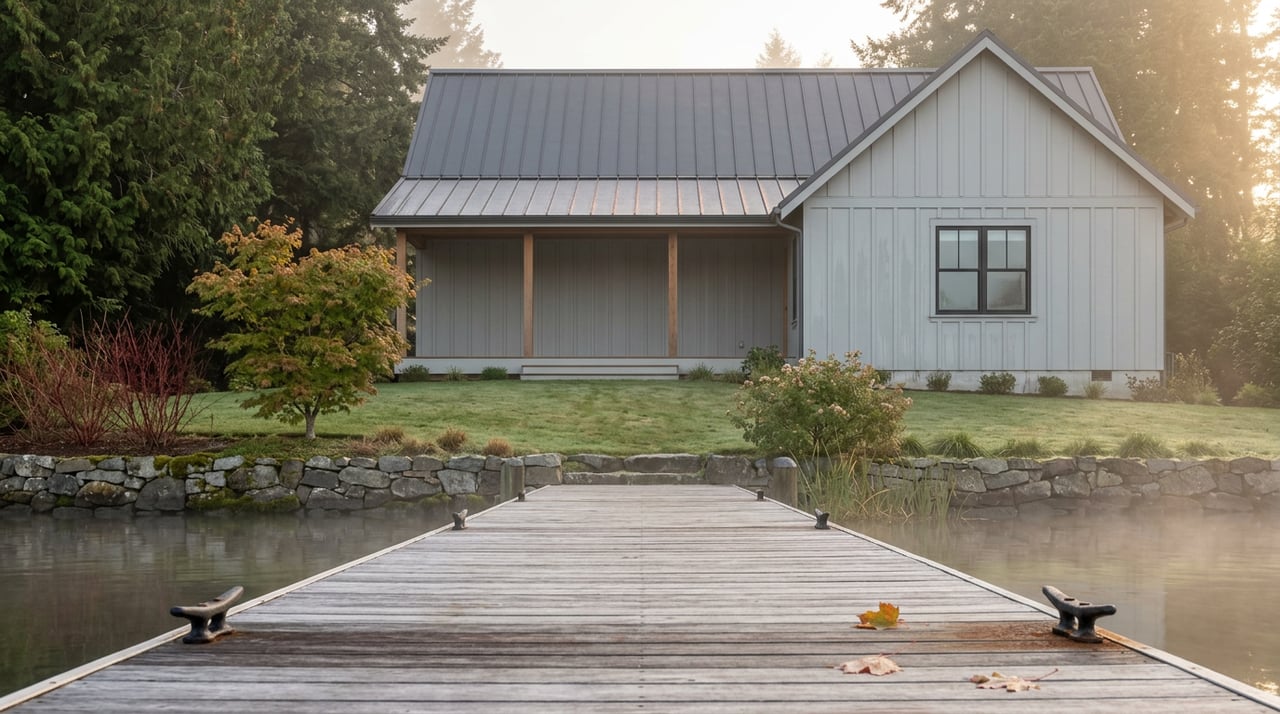
A buyer walks the dock at a Lake Stevens listing, looks out at the water, and assumes the property ends where the grass does. It doesn't. On this lake, the real boundary that governs what a seller can repair, replace, or even leave alone runs two hundred feet inland from the water's edge, whether or not anyone standing there knows it exists.
That line comes from the City of Lake Stevens Shoreline Master Program, which places shoreline jurisdiction over the lake itself, over Stitch Lake, over parts of Little Pilchuck and Catherine Creek, and over the land within 200 feet of each. If your listing touches any of that water, the sale isn't just a home sale. It's a home sale layered on top of a shoreline permitting system, and the sellers who plan for that layer close with far fewer surprises than the ones who find out about it from a buyer's inspector.
The comps you're using might be thinner than they look
Anyone pricing a Lake Stevens property this year has probably already seen the citywide numbers. As of August 2026, the median list price across Lake Stevens sat at $689,000, down roughly 8 percent from the same month in 2025, with homes spending a median of 55 days on market, essentially flat year over year.
Those numbers describe the city. They do not describe your dock.
True waterfront in Lake Stevens is a small, separate market, and small markets move in ways that look dramatic on a chart and mean very little on their own. In one recent three-month window, the narrow waterfront segment tracked separately from the citywide figures showed a sale price swing of more than 70 percent year over year. That is not a sign of a shoreline boom. It is a sign that only a handful of true waterfront homes closed in that stretch, and a handful of sales can swing a median wildly in either direction. A single $3 million closing or a single distressed sale can move the number more than an entire season of ordinary demand.
The practical takeaway for a seller: waterfront scarcity is real, and it does support a premium over comparable inland homes. But if your agent's pricing conversation leans on a headline percentage pulled from a thin data set rather than a small set of genuinely comparable recent closings, ask which sales are actually in that set. On a lake with limited true shoreline inventory, the difference between three good comps and three unlike ones is often six figures.
What the 200-foot line actually restricts
Shoreline jurisdiction is not a formality. It shapes what a buyer can do with the home after closing, which means it shapes what they're willing to pay for it before closing.
The city's Shoreline Master Program governs new construction, remodels, and additions within that 200-foot band, and it has produced a dedicated user guide specifically to help waterfront owners interpret the rules before they start a project. For an older home built before current setback and buffer standards existed, that guide matters more than it might for a newer build. A legally established structure that no longer meets today's standards can generally continue to exist, but expanding it in a way that increases the nonconformity is a different conversation entirely, one that often requires a shoreline exemption or a full permit review.
If your listing includes a covered boathouse from the 1970s, a bulkhead your grandparents' generation poured, or a dock that predates current code, that history is worth documenting before a buyer's agent asks about it. Vague answers read as red flags. A clear paper trail reads as confidence.
The permits that show up mid-transaction, not before
The friction rarely appears in the listing photos. It appears three weeks into escrow, when a buyer's inspector flags the dock or the bulkhead and someone asks what it would take to fix or replace it.
Washington's Department of Ecology sets a statewide dollar threshold for when dock work crosses from a minor project into a substantial development permit. As of the current threshold, effective since August 2023 and not due for another inflation adjustment until July 2028, that line sits at $28,000 for a dock built to replace an existing one at equal or lesser size, and $13,900 for any other new dock built in fresh water.
| Shoreline project | Regulatory trigger | Why it matters to a seller |
|---|---|---|
| Dock replacement or new dock | $28,000 threshold for like-for-like replacement; $13,900 for other new construction | Crossing the line means a substantial development permit, not just a building permit |
| Bulkhead repair | Repairs generally cannot expand the footprint of dry land | Significant alteration can be treated as new shoreline stabilization, triggering its own review |
| Buoys and swim markers | Permit required before placement | An unpermitted buoy is a small thing to disclose, and an easy thing for a buyer to ask about |
None of this means a seller needs to pull permits before listing. It means a seller who understands where these lines sit can price and market the home with a clear answer ready, instead of an anxious pause, when the question inevitably comes up.
One more rule worth knowing regardless of whether it affects your specific listing: the city's shoreline program does not allow houseboats or other live-aboard residential uses over the water. If a prospective buyer is picturing a floating structure as part of their vision for the property, that vision runs into the shoreline program before it runs into a contractor.
The lake has a schedule, and your listing photos should know it
Lake Stevens is not a static body of water. The city actively manages its level with an outflow structure called a weir, raising the lake in spring and summer to support recreation and lowering it again in fall to create storage capacity ahead of the wet season. A staff gauge in the North Cove area and a data logger track the level, with adjustments most critical in early spring and late fall when the city is working to get ahead of anticipated rainfall.
For a seller, this is not just a curiosity. It means the shoreline your buyer sees on a showing in July, with the water pushed high against the bank, looks different from the same shoreline in November. If your listing goes live during a lower-water stretch, a bulkhead or beach that will look generous in summer can look sparse in photographs taken at the wrong time of year. Timing a shoreline listing's photography and showings around the lake's own seasonal rhythm is a small decision with an outsized effect on how the water reads to a buyer.
The city also partners with Snohomish County on annual aluminum sulfate treatments to control phosphorus in the lake, an approach that replaced a less effective aeration system retired in 2012, and it monitors for invasive Eurasian watermilfoil alongside native aquatic plants. None of that changes anything about your title or your permits. It does mean that if a buyer asks about water clarity or weed growth near the dock, there's a real, documented answer rather than a guess.
The disclosure decision that's bigger for shoreline homes
Washington requires most residential sellers to complete Form 17, the state's disclosure statement under RCW 64.06, based on the seller's actual knowledge of the property at the time they complete it. Buyers generally have three business days from delivery to review it and, if they choose, walk away.
For an ordinary inland home, deciding whether to order a pre-listing inspection is a judgment call. For a waterfront home, it's a bigger one, because a standard home inspection often doesn't cover the dock or the bulkhead in the same depth a structural or marine specialist would. The moment a seller orders any inspection report, the actual knowledge standard means they're on the hook for disclosing what it found. That's not a reason to avoid inspecting the shoreline structures. It's a reason to decide deliberately, with your agent, whether a marine or dock-specific inspection is worth ordering before you list, rather than leaving that discovery to happen during someone else's due diligence period.
A few questions sellers ask before listing
Do I need a shoreline permit just to sell my house? No. Listing and selling a home doesn't require a shoreline permit. The permit questions arise around specific projects, like replacing a dock or altering a bulkhead, not around the transfer of ownership itself.
What if my dock or bulkhead needs work and I don't want to deal with permitting before I sell? You're not required to make repairs before listing. What matters is disclosing what you actually know about the condition, and being ready to talk through it clearly if a buyer's inspector raises it.
Selling a home on Lake Stevens is still, at its core, about presenting a beautiful property well and pricing it honestly. But when that property sits inside a 200-foot shoreline jurisdiction, the details that matter most are often the ones that never show up in a listing photo. Getting ahead of them, with clear documentation and a pricing strategy built on real comparables rather than a noisy headline number, is what separates a smooth closing from a stressful one.
If you're thinking about listing a waterfront or near-shore home on Lake Stevens and want a second set of eyes on your dock history, your comps, or your timing, Tanya Mock would love to help you think it through. Let's Connect.